Mexico Pavilion, the Seed for the New World: Food, Diversity and Heritage
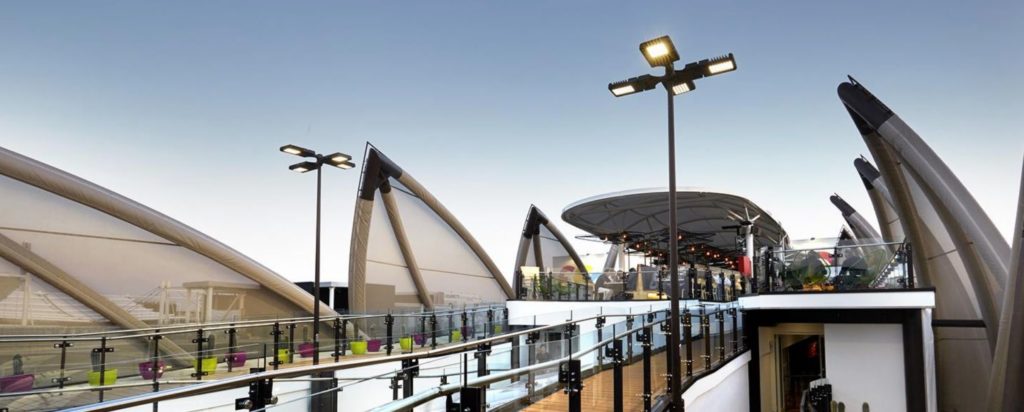
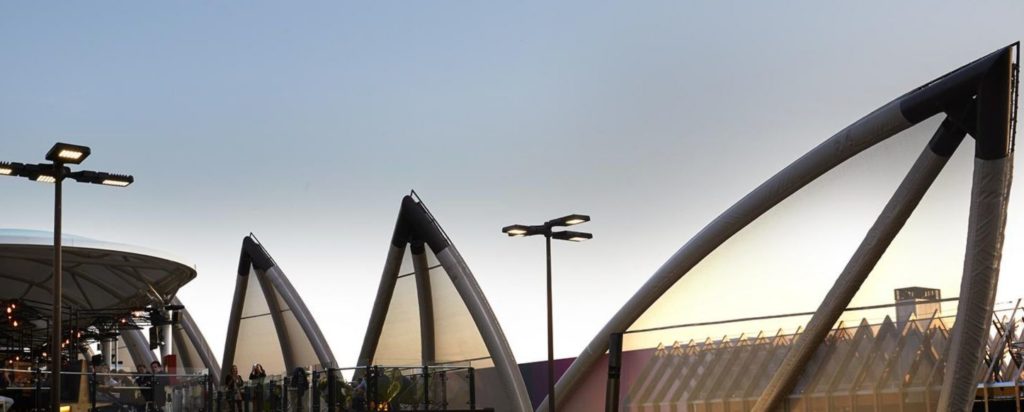
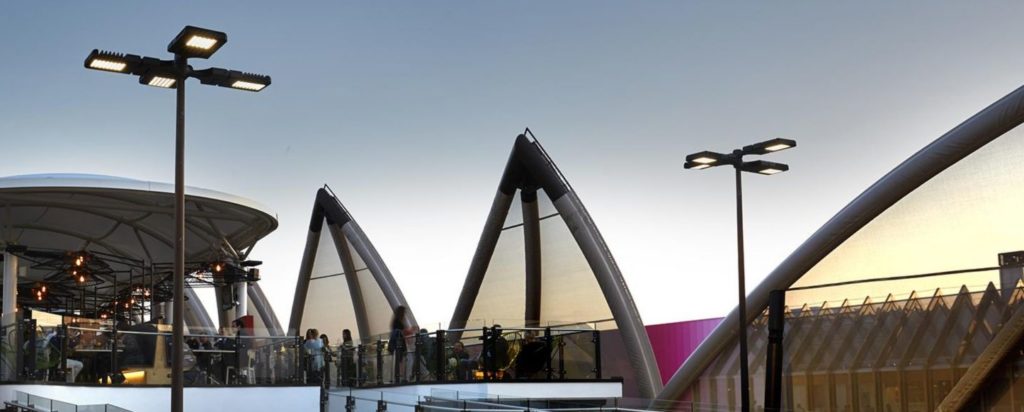
The architect Francisco López Guerra Almada, together with Jorge Vallejo and consulting biologist Juan Guzzy, bases the project on the most typical Mexican food, the corn.
The great external structure is inspired by the shape of a big cob, which is covering the pavilion of 1.910 m², and it is placed in a prime location, at the intersection of two main avenues. The interior, which is lit up by LED fittings called LEVANTE, offers an all-encompassing exhibition of typical products, surrounded by a flow of water that gives life to the gardens and takes visitors along spiral ramps, to explore the gastronomic, ecological and cultural riches of Mexico.


The Italian port network plays an important role for the economic and social development of the country. It is fundamental that the process of logistic and economic development and the growing use of the sea as a form of communication and transportation are accompanied by a minimisation of environmental impact.
The Livorno Darsena Terminal project is a combination of port re-qualification and environmental protection. The increase in efficiency of the lighting system, which has been carried out in collaboration with the Cariboni Group, has fully satisfied the project goals, allowing for very high lighting standards and guaranteeing energy savings of 65%, with payback in less than two years.
396 1000 W high-pressure sodium lamps were one by one substituted with the same number of LED lamps installed on 33 high-mast lights.
The project provided for an average lighting level of 30 lux with a general uniformity of 0.4 as provided for by the regulation UNI EN 12464-2 for outdoor work areas.
The product had to meet the following requirements:
- Protection level IP 66
- Insulation class II
- 10 kV common and differential protection system
- Fixing with AISI 316 stainless steel bracket.
Cariboni supplied 396 342 W M48 AREA FLOOD lights with LT-06 asymmetrical optics.
LT-06 optics are particularly suited to the illuminating of large areas due to 60° asymmetry which allows for the illuminating of an area the width of which is twice the height of the support to which the light is attached.